

Choosing a greenhouse frame material is one of those decisions that seems simple until you're actually sitting with the numbers, the site plan, and the pressure of a project timeline. Steel or aluminum — the question follows every serious greenhouse project at some point, and the answer shapes everything that comes after it: structural performance over decades, maintenance budgets, how well the building handles a bad winter, how efficiently it uses internal space. For farms, growing operations, and commercial facilities making real capital commitments, the wrong choice doesn't just cost money upfront — it costs money every season afterward. A Steel Structure Greenhouse and an aluminum greenhouse both work, both have genuine strengths, and both have conditions where they underperform. The comparison only becomes useful when it's anchored to specific project requirements rather than abstract material properties. That framing matters. This isn't about finding a universally correct answer. It's about understanding which material fits a particular scale, climate, and investment logic — and being honest about what each one asks of the people managing it over time.
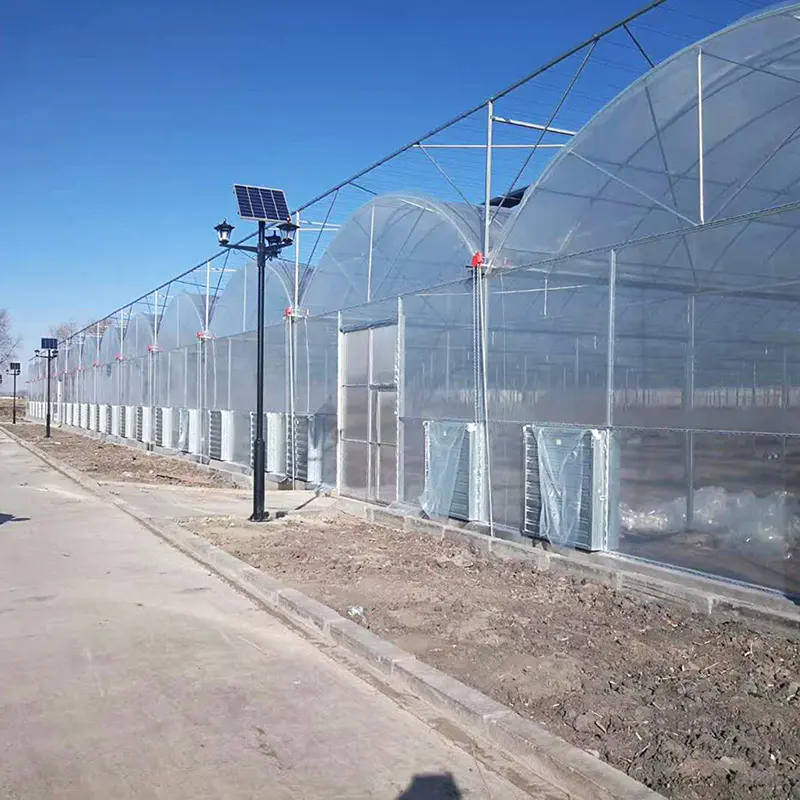
A steel frame greenhouse uses hot-dip galvanized or structurally treated steel as its primary load-bearing system. The galvanization process — immersing steel in molten zinc — creates a protective coating that slows corrosion significantly, making the material viable for outdoor agricultural environments where moisture, humidity, and temperature cycling are constant variables.
Steel's defining quality in this context is load capacity. Wide-span designs, multi-span connected configurations, heavy covering materials, tall ridge heights — all of these become structurally practical with steel in ways that aluminum struggles to match at comparable cost. That matters directly in Commercial Greenhouse Wholesale contexts where large footprints and efficient interior layouts drive productivity metrics.
Key structural features of steel frame greenhouses:
Here's something that doesn't always get discussed clearly: the durability of a Greenhouse with Steel Frame isn't just about the steel — it's about the quality of the corrosion protection applied to it. Hot-dip galvanizing produces a thicker, more uniform zinc coating than spray treatments or painted finishes. The zinc acts sacrificially, corroding before the underlying steel does. That protective mechanism works for years in properly treated material.
The problem is that galvanization quality varies considerably between suppliers. Poor coating is one of the more common causes of premature failure in steel greenhouses — and by the time the deterioration becomes visible, it's often already structural rather than cosmetic. When evaluating manufacturers, the galvanization specification deserves as much attention as the structural drawings. Well-treated steel in a properly maintained growing environment can remain sound for decades. Poorly treated steel in a humid greenhouse atmosphere can show serious corrosion within a few seasons.
Aluminum greenhouses use extruded aluminum profiles as the structural system. The material's corrosion resistance isn't something applied to it — it's inherent. Aluminum forms a stable oxide layer naturally when exposed to air, and that layer protects the metal beneath without galvanizing, painting, or periodic retreatment.
That natural stability makes aluminum particularly attractive for humid environments, coastal locations, or interior spaces where condensation is persistent and unavoidable. It genuinely doesn't rust in the way that unprotected or inadequately protected steel does. For operations where maintenance resources are limited or where the site conditions are persistently wet, this matters practically.
Other characteristics that define aluminum frame construction:
The trade-off for aluminum's lightness is load capacity — and that limit shows up clearly when projects scale up or when environmental conditions get demanding. Aluminum profiles that handle typical covering materials and moderate loads become less practical as span widths increase or as snow and wind loads grow. Large commercial greenhouses in regions with serious winters, or structures requiring wide internal clearances for machinery movement, typically exceed what aluminum can provide economically.
Material cost is the other side of this. Aluminum costs more per unit weight than steel. In a small greenhouse project, that difference is manageable. Scaled to a large Commercial Greenhouse Wholesale project, the cost gap becomes a significant line item in the investment calculation — one that's hard to justify when steel would perform better structurally for less money at that scale.
| Factor | Steel Structure Greenhouse | Aluminum Greenhouse |
|---|---|---|
| Load capacity | High — suitable for heavy loads and wide spans | Moderate — suited to lighter loads and smaller spans |
| Corrosion resistance | Depends on galvanization quality | Naturally resistant — no treatment needed |
| Material cost | Lower per unit weight | Higher per unit weight |
| Maintenance requirement | Periodic inspection of galvanized coating | Minimal — inherently stable |
| Span capability | Wide multi-span configurations | Better suited to single-span, moderate widths |
| Weight | Heavier — stronger foundation typically needed | Lightweight — simpler foundation requirements |
| Suitability for large commercial projects | Strong fit | Less practical at very large scale |
| Climate suitability | Well-suited with quality galvanization | Well-suited especially in humid or coastal areas |
| Custom Size Greenhouse compatibility | Highly flexible for large custom configurations | Flexible for smaller custom configurations |
| Aesthetic appeal | Industrial, functional | Clean, polished appearance |
In mild climates with low wind speeds and minimal snow, both steel and aluminum perform reliably across a reasonable range of greenhouse sizes. The structural advantage of steel becomes genuinely significant — not just theoretically — when any of the following conditions apply:
In these situations, choosing aluminum isn't just a structural compromise — it becomes a risk factor for the investment. A greenhouse that deforms or fails under demanding weather conditions creates production losses and emergency repair costs that quickly exceed any material saving from the original construction decision. The initial cost comparison looks different when you factor in what happens when the cheaper option doesn't hold.
For single-span hobby greenhouses, retail garden centers, research facilities with controlled environments, or educational horticultural spaces, the structural demands are genuinely lower. Aluminum performs reliably in these settings, and the natural corrosion resistance reduces ongoing maintenance in ways that have real operational value.
The weight advantage also applies in specific situations that often get overlooked — rooftop greenhouse installations where structural loading on the building below is a constraint, or remote sites where heavy construction equipment can't easily access the location. In those contexts, aluminum's lighter components aren't just a handling convenience; they're a meaningful construction advantage.
A greenhouse is a long-term investment. Its structural material needs to perform across the full range of conditions a location experiences — not just averages, but the periodic events that stress the structure. Climate consideration isn't an abstract planning exercise; it directly shapes which material will perform as expected over the operational life of the building.
Climate implications by region type:
Thermal expansion and contraction from seasonal and daily temperature cycling affects all metal frame systems. Aluminum expands and contracts more than steel across the same temperature range. In large structures, this movement needs to be accommodated deliberately in the design — expansion joints, flexible connections, and appropriate fixing details prevent stress from accumulating in ways that eventually damage either the structure or the covering material attached to it.
For small to medium greenhouses, thermal movement is manageable within standard design approaches. In large Custom Size Greenhouse configurations — particularly long continuous structures — the manufacturer and designer need to address this behavior explicitly rather than treating it as a secondary concern. Buyers evaluating large-scale projects should ask how the manufacturer handles thermal movement in their standard design details.
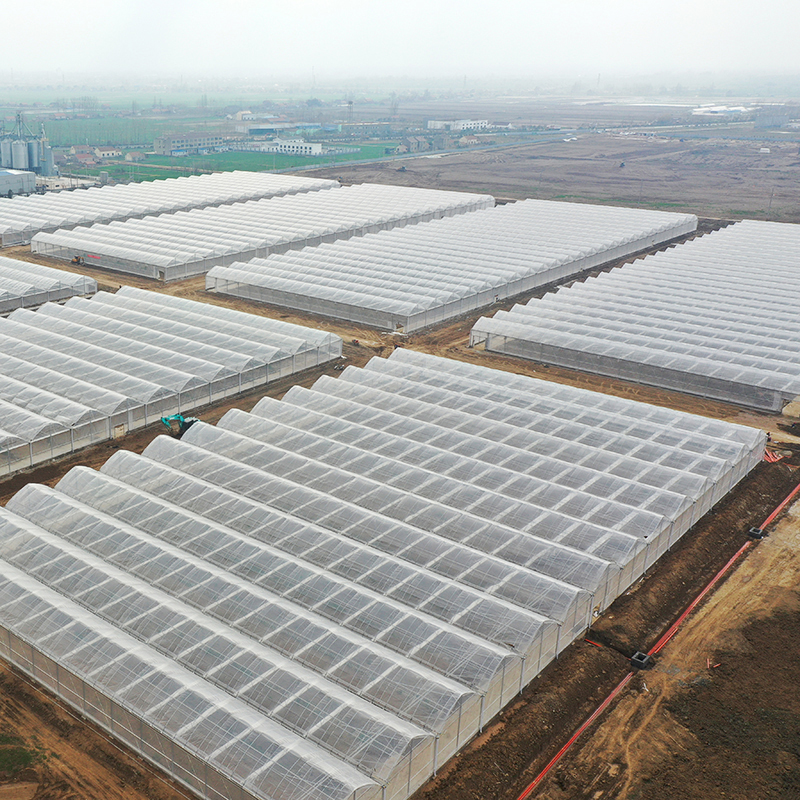
Commercial Greenhouse Wholesale projects — covering substantial growing areas for vegetable production, floriculture, or large-scale horticultural operations — have requirements that consistently favor steel frame construction. The economics work differently at this scale, and so do the structural demands.
Several practical factors converge at commercial scale:
For farms planning to scale growing capacity, or for greenhouse contractors building facilities for agricultural clients operating at volume, these practical advantages consistently make steel the structural default. The higher upfront investment in steel versus aluminum at large scale is typically recovered through better structural performance, lower long-term maintenance burden, and the ability to build efficiently at the scale the operation actually needs to function.
One of the practical advantages of steel frame construction at commercial scale is the ability to design wide, column-free interior spaces. Internal columns interrupt growing rows, complicate machinery movement, and reduce the usable growing area relative to the covered footprint. Steel's structural capacity allows wider spans and fewer internal supports, which translates directly into more usable growing space and more efficient internal layouts for the crops or systems housed within.
Aluminum greenhouses at similar span widths either require more internal support columns or use heavier profiles that approach steel weight and cost — at which point the material's original advantages diminish. For commercial operations where internal space efficiency drives productivity and revenue, this design consideration has real economic consequences that compound over the life of the operation.
Both materials accommodate Custom Size Greenhouse designs, but the practical flexibility differs at larger scales. Steel's structural properties allow configurations that would be challenging or cost-prohibitive in aluminum — unusually wide spans, irregular plan geometries, tall ridge heights, or integration of attached service structures and processing spaces. Custom Greenhouse Manufacturers working at commercial scale use steel precisely because it accommodates the range of design requirements that commercial agricultural clients actually bring to projects.
For operations that need a greenhouse configured around specific site constraints, equipment dimensions, or proprietary growing system requirements, steel frame construction gives the manufacturer meaningful design latitude to deliver a structure that genuinely fits the project rather than requiring the project to fit the material's limitations.
For smaller installations — specialty growing spaces, retail garden centers, educational facilities, research units — aluminum's extrusion process allows relatively straightforward customization of profile dimensions and connection systems. Custom Greenhouse Manufacturers working in the smaller commercial and semi-commercial segment often use aluminum because it's easier to handle on site, faster to assemble, and well-suited to the scale of project these clients need.
The key principle is matching the level of customization to what the material can practically deliver. Aluminum custom configurations work well within the structural limits of the material. Pushing beyond those limits to achieve scale or environmental performance that aluminum isn't designed for adds cost without proportional performance benefit — a poor trade that becomes more apparent over time.
Purchase price is a visible cost in any greenhouse procurement decision, but it is not the complete picture. Maintenance costs, repair frequency, operational disruptions from structural issues, the cost of modifications as needs change — all of these factor into the real cost of a greenhouse over its full operational life. Evaluating only the initial outlay routinely produces decisions that look right on paper and prove expensive in practice.
A useful lifecycle cost comparison considers:
Neither material is categorically more economical across all scenarios. The lifecycle cost comparison shifts considerably depending on scale, climate aggressiveness, quality of the original construction, and how the structure is managed over time.
Neglected maintenance affects both materials, but the consequences diverge in important ways. Aluminum with surface damage in an aggressive environment may develop localized surface oxidation that affects appearance but rarely progresses quickly into structural compromise. Steel with damaged galvanization in a persistently wet growing environment can develop corrosion that progresses into the base metal — a more serious problem that, if left unaddressed, becomes structural rather than cosmetic.
This difference in failure mode is worth factoring into the choice for projects where ongoing maintenance resources are genuinely limited. Aluminum's lower maintenance dependency is a real operational advantage in those contexts, even when its structural limitations make it unsuitable for large commercial applications. Understanding this trade-off honestly is part of making a decision that holds up over the project's full life.
A greenhouse project is likely to favor steel frame construction when:
An aluminum greenhouse becomes the more practical choice when:
The comparison between steel and aluminum greenhouses is ultimately a decision-making framework, not a fixed verdict. Both materials have legitimate applications, and the outcome that serves a project well comes from matching the material to the actual requirements rather than defaulting to one option out of familiarity or initial price attraction.
For agricultural businesses, farm developers, greenhouse contractors, and procurement teams working through this decision with real projects in the background, Taizhou Sunshine Garden Products Co., Ltd. manufactures both steel frame greenhouse structures and aluminum greenhouse systems, with Custom Size Greenhouse configurations available across a range of project scales — from mid-scale commercial installations to large agricultural facilities requiring multi-span designs and specialized internal layouts. Their production capabilities span the structural range covered in this comparison, with design support available for project-specific requirements including multi-span configurations, climate-adapted structural specifications, and Commercial Greenhouse Wholesale orders at volume. Working with a manufacturer that understands both structural systems and can engage directly with the trade-offs relevant to a specific project's scale, location, and operational goals takes significant uncertainty out of the procurement process. If your project is currently in the planning or procurement stage, reaching out to discuss frame options, custom configurations, and project-specific requirements is a straightforward next step toward a decision made on solid ground.

 英语
英语 俄语
俄语 德语
德语 西班牙语
西班牙语 法语
法语

.jpg?imageView2/2/w/800/h/800/format/webp/q/75)
.jpg?imageView2/2/w/800/h/800/format/webp/q/75)
.jpg?imageView2/2/w/800/h/800/format/webp/q/75)
.jpg?imageView2/2/w/800/h/800/format/webp/q/75)
.jpg?imageView2/2/w/800/h/800/format/webp/q/75)
-1.jpg?imageView2/2/w/800/h/800/format/webp/q/75)
.jpg?imageView2/2/w/800/h/800/format/webp/q/75)
-1.jpg?imageView2/2/w/800/h/800/format/webp/q/75)
.jpg?imageView2/2/w/800/h/800/format/webp/q/75)
-1.jpg?imageView2/2/w/800/h/800/format/webp/q/75)
-1.jpg?imageView2/2/w/800/h/800/format/webp/q/75)