

Upgrading a greenhouse or nursery operation sounds straightforward until you get to the details. Tray selection alone can quietly affect how efficiently your growing space functions — drainage performance, load capacity, maintenance frequency, and long-term cost all hinge on a decision that often gets made without enough information. Whether you are fitting out a new facility or replacing aging equipment, the choice between plastic and metal matters more than it might appear. A Bench Tray is not just a surface to hold plants; it is a functional component of how your growing system performs day to day, season after season.
At its core, a Bench Tray is a flat or lipped surface that sits on greenhouse benching structures to support plant containers, propagation trays, or growing media. It manages drainage, contains irrigation runoff, and provides a stable platform for whatever is growing above it.
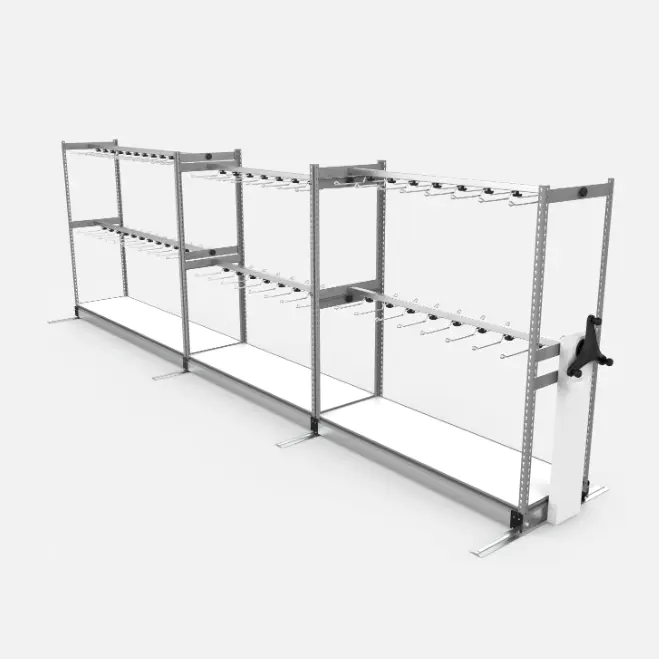
Material determines nearly everything about how it performs in practice:
Plastic and metal each have genuine strengths — and real limitations. The comparison below works through both, honestly.
Plastic Bench Trays are produced from UV-stabilized polypropylene or similar polymer materials. That matters in greenhouse settings where sunlight, irrigation water, and chemical inputs are constant features of the environment.
Corrosion is simply not a concern with plastic. Fertilizer salts, fungicides, water pH variation — none of these degrade plastic the way they affect uncoated metal over time. For growers operating in humid, chemically active growing environments, that resistance removes a maintenance variable that can otherwise become a recurring cost.
Handling is another practical advantage. Plastic trays are light enough to reposition without extra labor, which suits operations that reconfigure bench layouts seasonally or move trays between growing zones. In mobile bench systems, weight reduction across hundreds of trays adds up to a meaningful difference in effort and equipment wear.
Where plastic does have limitations:
Metal trays — typically galvanized steel or aluminum — offer structural strength that plastic cannot match at equivalent thickness. For commercial greenhouse operations carrying heavy loads across wide bench spans, that structural rigidity is a genuine operational requirement, not a preference.
Galvanized steel resists corrosion through a zinc coating, and hot-dip galvanizing provides more durable protection than simple painted or electro-galvanized finishes. Aluminum takes a different approach: it does not rust at all, making it well-suited for continuously wet environments without the coating maintenance that steel requires.
Metal trays also hold their shape under sustained load. Where a plastic tray might develop a slight bow under heavy planters over months of use, a properly specified metal tray holds flat. In commercial settings where uniform bench height affects irrigation uniformity and worker ergonomics, that dimensional stability carries operational weight.
The practical trade-offs:
This is one of the questions worth thinking through carefully, because the answer shifts depending on the specific materials and finishes involved.
Plastic is entirely indifferent to humidity. No coating is required, no maintenance treatment extends its moisture resistance — the material itself is stable. Over years of wet-dry cycling, plastic trays do not corrode, pit, or delaminate. Cleaning involves little more than a pressure rinse between crop cycles.
Metal requires more attention in persistently humid conditions. Even well-galvanized trays eventually experience coating wear, particularly at joints, cut edges, and areas where trays contact bench frames. Once the zinc layer is compromised, corrosion progresses. Regular inspection and spot treatment extend service life meaningfully — but they represent an ongoing maintenance commitment that plastic does not require.
For operations in tropical climates, high-humidity growing facilities, or year-round irrigated environments, this difference in maintenance burden is worth factoring into total cost of ownership, not just purchase price.
Drainage design is largely a product function rather than a strict material property — but material does influence what drainage configurations are practical to manufacture.
Plastic trays are typically injection-molded or thermoformed, which allows for integrated drainage channels, sloped floor profiles, and precisely placed drainage holes without secondary operations. The flexibility of plastic forming means drainage geometry can be optimized into the tray design at relatively low production cost.
Metal trays achieve drainage through perforated bases, open-mesh designs, or fabricated channel profiles. These work well, but the forming process is less flexible than plastic molding for complex drainage geometries. On the other hand, expanded metal or mesh metal trays provide essentially unrestricted drainage and airflow beneath plants — an advantage in applications where root zone air circulation matters.
Neither material is inherently better at drainage. It depends on:
| Feature | Plastic Bench Tray | Metal Bench Tray |
|---|---|---|
| Weight | Light, easy to handle | Heavier, requires more handling effort |
| Corrosion resistance | Inherent, no coating needed | Depends on galvanizing or alloy type |
| Load capacity | Moderate, varies by grade | High, suitable for heavy containers |
| Maintenance requirement | Low — rinse clean between cycles | Moderate — inspect and treat coating wear |
| Lifespan in wet conditions | Long with UV-stabilized materials | Long with quality galvanizing and care |
| Drainage flexibility | High — complex profiles possible | Good — mesh and perforated options available |
| Upfront cost | Generally lower | Generally higher |
| Long-term cost | Low maintenance offsets initial price | Durability offsets higher starting cost |
| Mobility and reconfiguration | Easy | More labor-intensive |
| Structural rigidity | Moderate | High |
Reading across that comparison, neither option is categorically stronger. Each performs better in specific conditions — and the conditions that matter are defined by your operation, not by generic rankings.
Plastic trays fit naturally into operations that prioritize handling ease, corrosion resistance, and flexibility. Specific scenarios where they tend to perform well:
Metal trays suit operations where structural load, long bench spans, and heavy-use commercial environments are the operating reality. Situations that favor metal:
It often is — though the calculation is more nuanced than comparing sticker prices.
Plastic trays cost less upfront. Replacement cycles vary by UV exposure and load conditions, but plastic does not require the ongoing inspection and maintenance that metal needs to preserve coating integrity. Over time, in humid or chemically active growing environments, those maintenance savings can offset the lower structural performance.
Metal trays cost more upfront. In operations that load trays heavily and run continuous year-round production, the structural durability means fewer replacements and more predictable performance over the facility's lifespan. Maintenance is real but manageable, and quality galvanized metal in well-maintained facilities lasts considerably longer than standard plastic in comparable service.
The honest answer is that long-term cost depends on how hard the trays are worked and how well they are maintained — not just what material they are made from.
Before finalizing a tray specification, it is worth running through a few practical questions:
Those answers will point more reliably toward the right material than any generalized comparison.
There is no single answer to which tray material is better — only answers that fit specific operations better than others. Plastic performs well where handling ease, moisture resistance, and lower upfront investment matter. Metal earns its place where structural load, long bench spans, and heavy-duty commercial use are the daily reality. The growing environment, the load demands, the maintenance program, and the long-term facility plan all feed into a decision that has real operational consequences either way. For growers who want guidance matched to their specific greenhouse or nursery setup, Taizhou Sunshine Garden Products Co., Ltd. offers Bench Tray solutions across both material types, with the product knowledge and application experience to help procurement teams make selections that hold up over time. If you are evaluating options for a new facility or an upgrade to existing infrastructure, reaching out with your project details is a practical starting point.

 英语
英语 俄语
俄语 德语
德语 西班牙语
西班牙语 法语
法语

.jpg?imageView2/2/w/800/h/800/format/webp/q/75)
.jpg?imageView2/2/w/800/h/800/format/webp/q/75)
.jpg?imageView2/2/w/800/h/800/format/webp/q/75)
.jpg?imageView2/2/w/800/h/800/format/webp/q/75)
.jpg?imageView2/2/w/800/h/800/format/webp/q/75)
-1.jpg?imageView2/2/w/800/h/800/format/webp/q/75)
.jpg?imageView2/2/w/800/h/800/format/webp/q/75)
-1.jpg?imageView2/2/w/800/h/800/format/webp/q/75)
.jpg?imageView2/2/w/800/h/800/format/webp/q/75)
-1.jpg?imageView2/2/w/800/h/800/format/webp/q/75)
-1.jpg?imageView2/2/w/800/h/800/format/webp/q/75)